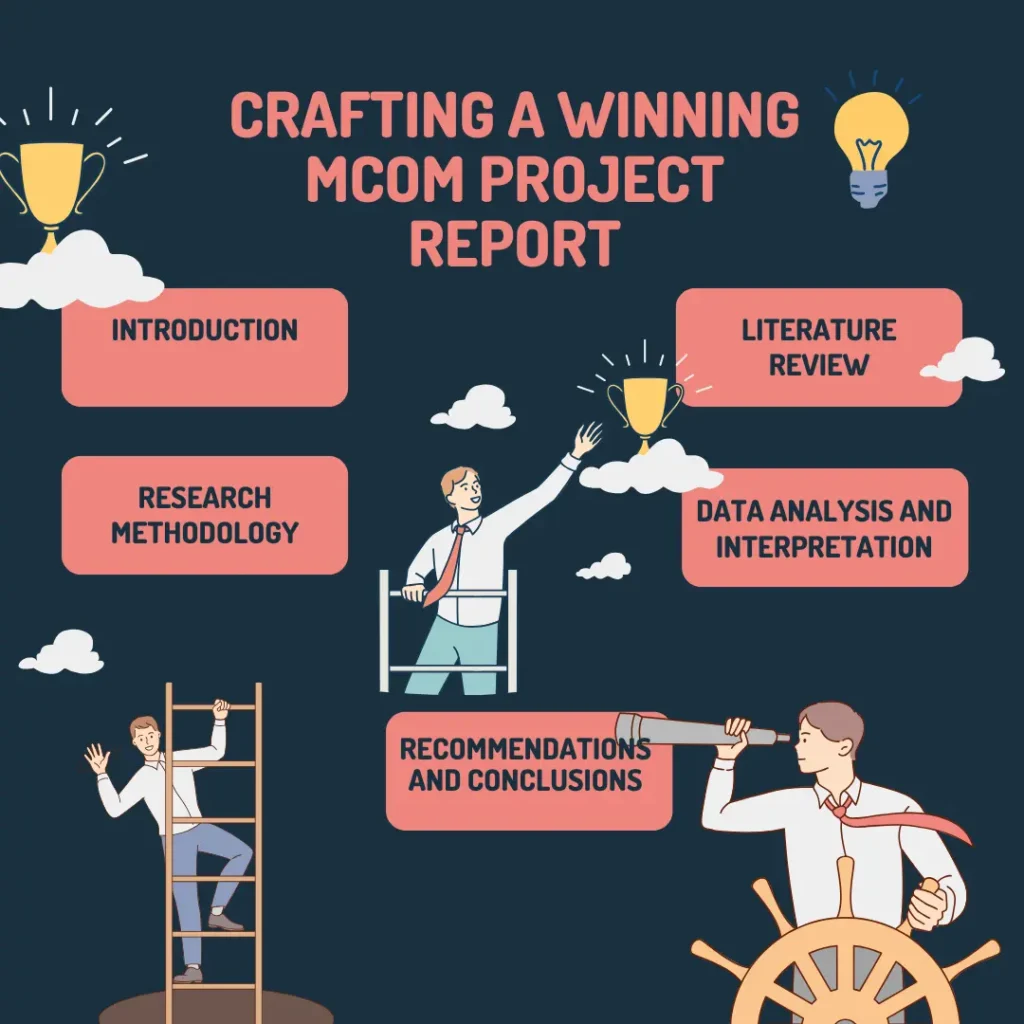
A well-crafted project report is not just a requirement for your MCOM degree, it’s a reflection of your hard work and research efforts. A well-organized report makes it easier for the reader (typically your supervisor or examiner) to follow your arguments, understand your findings, and appreciate the contribution your research makes to the field of commerce.
Below is a detailed breakdown of each section in the MCOM project report, including essential components and tips on how to structure them effectively.
Cover Page
The cover page is the first thing the examiner will see, so make sure it includes all required details in a clean and professional layout.
What to Include:
- Title of the Project (clear and concise)
- Your Name
- Enrollment Number
- Course Code (MCOP-001)
- Name of Your Supervisor/Guide
- Name of the School and Department
- Date of Submission
- University Name (IGNOU)
Tip: Make sure the formatting follows IGNOU’s official guidelines, such as font size and style. This is typically Arial, 12pt, and should be centered properly on the page.
Acknowledgments
This section is where you express gratitude to people who helped you during your research and project work.
What to Include:
- A brief note of thanks to your project guide, academic mentors, or anyone else who provided significant assistance (e.g., family, colleagues).
- If you used external resources or support (like research participants, organizations, or experts), mention them here.
Tip: Keep the tone formal and concise. Do not over-explain or get too personal—acknowledge only the most relevant contributors.
Table of Contents
The table of contents (TOC) lists the major sections of your report with page numbers for easy navigation. It should be automatically generated by your word processor, especially if you’ve used headings appropriately.
What to Include:
- Chapter Titles and Subheadings
- Page Numbers for each section (use automatic tools like Word or Google Docs to generate this for consistency)
Tip: Use Headings and Subheadings in your document structure (Word or Google Docs styles) so that the table of contents updates automatically.
List of Tables, Figures, and Appendices
This section is optional but can be useful if your project contains several tables, figures, charts, or appendices.
What to Include:
- A list of all the tables, figures, and appendices with page numbers.
- This helps the reader quickly locate data, charts, or additional material you reference in the body of your report.
Abstract
The abstract is a concise summary of your entire project. It provides a snapshot of your research question, methodology, findings, and conclusions.
What to Include:
- Research Question: What was the problem or topic of your research?
- Methodology: Briefly mention if you used qualitative, quantitative, or mixed methods.
- Findings: Summarize key findings from your research.
- Conclusion: Provide a quick overview of what your research concludes.
Tip: Keep the abstract between 200-300 words. It should be clear and to the point. Don’t introduce new concepts or jargon in this section.
Introduction
This is where you set the stage for your entire research project. The introduction should explain the context of your research, why it’s important, and what your research aims to achieve.
What to Include:
- Background Information: Provide context for your topic. What’s the state of the field, and why is your research needed?
- Research Problem: Clearly define the problem or gap your research aims to address.
- Research Objectives: State the main goals of your research (e.g., to explore, evaluate, or analyze a particular issue).
- Research Scope: Explain the boundaries of your research—what you will cover and what you won’t.
- Significance of Study: Justify why this research matters and its potential impact on the field.
Tip: Write this section in a way that draws the reader’s attention and convinces them that your research is relevant and important.
Literature Review
The literature review is where you review existing research on your topic. This section demonstrates your understanding of the field and helps establish a theoretical framework for your study.
What to Include:
- Review of Key Studies: Summarize the findings of important studies and theories related to your topic.
- Identify Gaps: Highlight any gaps or areas where existing research is lacking, justifying the need for your research.
- Theoretical Framework: Discuss the models, theories, or concepts you are using to guide your research.
Tip: Structure the literature review thematically (group studies by theme or methodology) or chronologically (discuss studies in the order they were published) to help guide your reader through the material.
Research Methodology
This section details how you conducted your research. Be specific about your approach, methods, and tools.
What to Include:
- Research Design: Explain whether you used qualitative, quantitative, or mixed methods and why.
- Sampling Method: Describe the sample (e.g., size, selection criteria, demographics).
- Data Collection Methods: Outline the tools or techniques used (e.g., surveys, interviews, observations).
- Data Analysis: Explain how the data was processed and analyzed (e.g., statistical analysis, thematic analysis).
- Limitations: Mention any constraints, such as time, resources, or sample size, that may have impacted your research.
Tip: This section should be detailed enough so that someone could replicate your study. Use diagrams or flowcharts to visually explain the methodology if necessary.
Data Analysis and Interpretation
This is the heart of your project, where you present and interpret your findings. Here, you showcase your data in the form of graphs, tables, or charts, and provide your analysis.
What to Include:
- Presentation of Data: Show your raw data using appropriate visual tools (tables, charts, graphs).
- Analysis: Provide a detailed interpretation of the data. What patterns or trends did you find?
- Statistical Analysis (if applicable): Include any statistical tests or significance levels you used in your analysis.
- Comparisons: Compare your findings with existing literature (do they support or contradict previous research?).
Tip: Be objective and ensure that your interpretation is tied directly to the research questions and objectives outlined in your introduction.
Recommendations and Conclusions
Based on your findings, this section will discuss what the results mean and how they can be applied in practice. It also serves as a summary of your study and a final answer to your research question.
What to Include:
- Conclusions: Summarize the main findings and what they reveal about your research question.
- Recommendations: Offer suggestions for future research or practical applications of your findings.
- Implications: Discuss how your findings contribute to the field of commerce or offer solutions to real-world problems.
Tip: Be concise and ensure your conclusions are drawn from the analysis presented earlier in the report. Avoid introducing new information here.
References/Bibliography
This section lists all the sources you’ve cited in your project, such as books, journal articles, and websites.
What to Include:
- Follow APA, MLA, or Harvard referencing styles (as required by IGNOU).
- Ensure all sources are properly cited in-text and listed correctly in the references section.
Tip: Be thorough and consistent in your citation style to avoid any issues with plagiarism.
Appendices
The appendices include any extra material that supports your project but is too detailed or lengthy to include in the main report (e.g., raw survey data, interview transcripts, supplementary charts).
What to Include:
- Survey Questionnaires
- Interview Transcripts
- Additional Tables, Graphs, or Data
Tip: Label each appendix clearly (e.g., Appendix A: Survey Questionnaire) and reference them in the main body of the report.